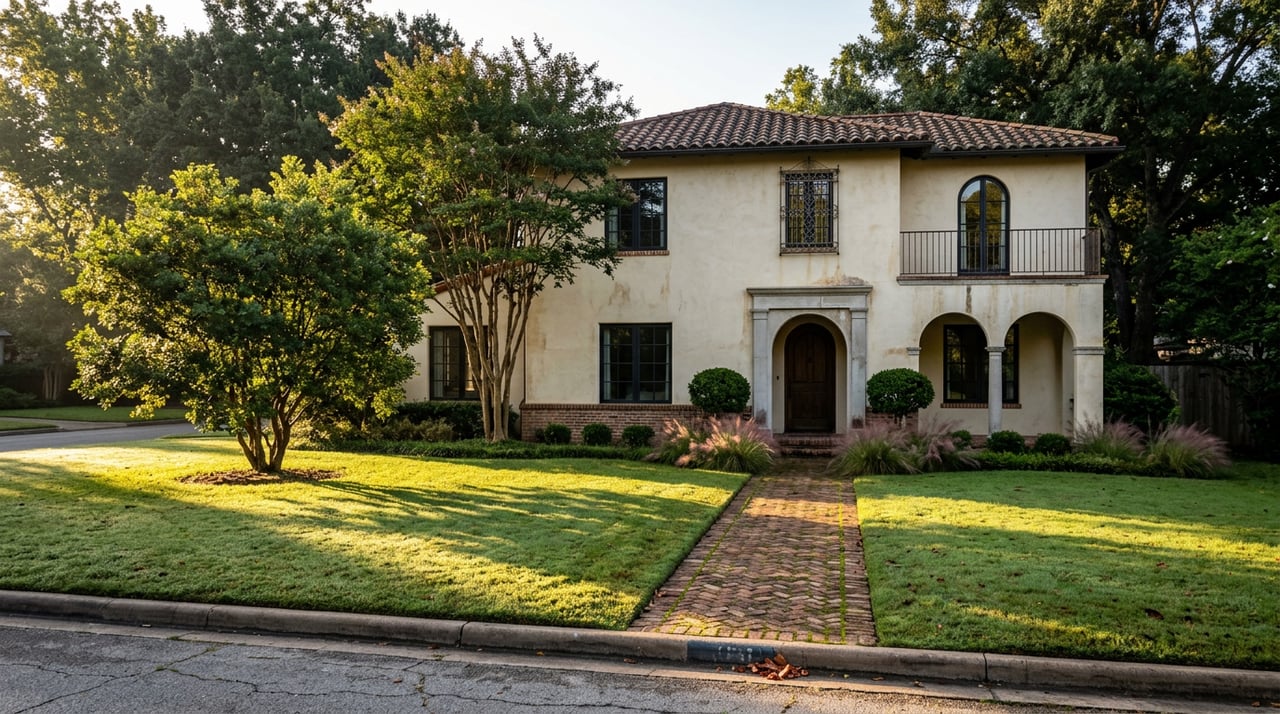
You are touring a house a block off Broadway, and a patrol car passes with "City of Alamo Heights" lettered across the door. Not San Antonio. A different department, different chain of command, different budget line. Most buyers clock the mature oaks and the Tudor roofline and miss the detail that matters more: the four walls you are about to make an offer on sit inside a separate city, one with its own government, its own tax authority, and its own permitting calendar that has nothing to do with San Antonio's.
That distinction is not trivia. It is the mechanism behind almost everything a buyer or seller notices about Alamo Heights and cannot quite explain: why the tax bill lands heavier than the price tag suggests, why a teardown-rebuild project runs on a slower clock than it would three streets over, and why the housing stock behaves like a fixed, closed system instead of a normal expanding market. Here is what actually sits behind the city line, and what to check before you write an offer.
A City With Its Own Border, Not Just Its Own Zip Code
Alamo Heights was incorporated as its own city in 1922, and it has stayed that way ever since, a roughly two-square-mile municipality completely encircled by San Antonio. Look at its four sides and the pattern gets more interesting: Lincoln Heights to the north and Brackenridge Park and Fort Sam Houston to the south are San Antonio districts, but Olmos Park to the west and Terrell Hills to the east are independent cities in their own right, the same legal category as Alamo Heights itself. Buyers comparing these addresses are not comparing San Antonio neighborhoods against each other. They are comparing three separate small cities that happen to share a metro area.
That independence is not ceremonial. The city runs its own police department, its own fire department, and its own public works crew, all funded through a municipal budget San Antonio has no say in. It shows up in real time, too. In August 2026, the City of Alamo Heights declared its own Stage 2 water restrictions in response to Edwards Aquifer Authority pumping limits, a decision made and announced by Alamo Heights city government, independent of whatever San Antonio was doing on the same aquifer. That is what a functioning separate city looks like in practice, not just on an incorporation certificate from a century ago.
The Tax Bill Has More Layers Than the Listing Sheet Shows
Because Alamo Heights is its own taxing jurisdiction, a buyer here is stacking levies that a San Antonio buyer three blocks away is not. The City of Alamo Heights sets and collects its own ad valorem tax, contracted through Bexar County for billing convenience so owners get one consolidated statement rather than two separate ones in the mail. But convenience in billing does not mean convenience in cost. On top of the city's own rate sits Alamo Heights ISD, then Bexar County, then whatever special districts apply to the parcel.
One property tax analytics firm that tracks Bexar County assessments puts the median effective property tax rate in Alamo Heights at roughly 2.08 percent of assessed value, well above the 1.02 percent national median, and their model shows the resulting annual bill running into the tens of thousands of dollars on a well-appraised property under current 2026 assessed values, dwarfing the roughly $2,400 national median tax bill. The number that matters for underwriting a purchase is not the sale price alone. It is the sale price plus this separate, four-layer tax stack that a comparable house in a San Antonio-proper zip code simply does not carry in the same combination.
Before you get attached to a specific house, ask your title company or the seller for the actual tax certificate, not an estimate. It should break the bill into its component parts: city, AHISD, county, and any special district. That breakdown tells you which piece is driving the number and whether it is likely to move.
The Permitting Clock Runs Once a Month
The second layer buyers underestimate is process. Alamo Heights enforces its own zoning code, separate from San Antonio's, and any request that falls outside the code, a setback variance, a height exception, an impervious cover allowance, goes to the city's Board of Adjustment. That board has five regular members and two alternates, serves two-year terms, and meets once a month, on the first Wednesday, in the City Council Chambers at 6116 Broadway. It functions in a quasi-judicial capacity, meaning it hears and rules on specific variance requests rather than rubber-stamping paperwork.
This is not a hypothetical bottleneck. The zoning map itself is actively revised through city council ordinance, not left static. In 2026 alone, the city passed ordinances rezoning a multi-family-zoned stretch at 6801, 6815, and 6823 Broadway, along with a single-family-zoned parcel at 116 Tuxedo Avenue, to a parking designation, and separately rezoned a parcel at 5701 North New Braunfels Avenue from multi-family to office use. Zoning designations on individual lots here change through real, dated council action, which means the designation on a property you are considering today may not be the one that applied a year ago, or the one that will apply next year.
For a buyer planning a teardown-rebuild or a significant addition, and the housing stock's age makes that a common ambition, the code itself is written to control scale, not just approve or deny. Alamo Heights' zoning ordinance explicitly directs the city to keep new construction proportional to lot size, to adjust absolute height limits so new builds do not tower over neighboring rooflines, and to limit how much a garage or parked cars dominate the street-facing view. A design-forward renovation that would sail through in an unincorporated area may need a variance here, and that variance request has to wait for the first Wednesday of next month, not the next available inspector slot.
Why the Math Behaves Differently Here
Put the tax layer and the permitting layer together and the pricing pattern in Alamo Heights stops looking mysterious. The housing stock was largely built out between the 1920s and the 1960s, on a footprint that has not grown since. There is no undeveloped land for new subdivisions inside a two-square-mile incorporated city that has been fully platted for decades. Every transaction here is a trade for a piece of a fixed inventory, not a slice of an expanding one.
That is a different kind of scarcity than "desirable San Antonio neighborhood." It is closer to scarcity in the way a small, closed market behaves: supply cannot respond to demand by building more, so price absorbs the pressure instead. A buyer comparing Alamo Heights to a growing outer-loop San Antonio submarket, where builders can and do respond to demand with new inventory, is comparing two markets that run on different physics. One has a release valve. The other does not.
What to Actually Do Before You Write an Offer
- Pull the actual consolidated tax certificate for the specific parcel and have your lender or title company itemize city, AHISD, county, and special district portions separately, rather than relying on a blended estimate.
- Confirm the current zoning designation on the exact lot, not the block, since individual parcels have been rezoned by council ordinance within the current calendar year.
- If your plans include a teardown, a second story, or a significant addition, check the Board of Adjustment's meeting calendar early. A variance request that misses this month's first Wednesday waits a full month, and that delay belongs in your renovation timeline before closing, not after.
- Ask whether the property or its immediate neighbors have gone before the Board of Adjustment recently. A pattern of variance requests on a block tells you something about how the code is actually being applied there in practice.
A Few Questions Worth Asking Directly
Is Alamo Heights part of San Antonio? No. It is a separately incorporated city, completely surrounded by San Antonio but governed, policed, and taxed on its own.
Do Alamo Heights homeowners pay both San Antonio and Alamo Heights taxes? No. Residents pay Alamo Heights city tax, Alamo Heights ISD tax, and Bexar County tax, billed together through the county for convenience. They do not pay a separate San Antonio municipal tax on top of it.
Can I add a second story or rebuild without city approval? Any project that meets the standard zoning code for its district can typically move through normal permitting. Anything that requires a setback, height, or coverage exception needs a variance from the Board of Adjustment, which meets monthly, so that step should be built into your project timeline from the start.
Alamo Heights rewards buyers who understand it is a small city first and a prestige address second. The tax stack, the zoning calendar, and the closed housing supply are not footnotes to the sale, they are the sale. If you are weighing a purchase here against Olmos Park, Terrell Hills, or a San Antonio-proper block that looks similar on paper, Claudia Wheeler can walk the actual tax certificate and zoning history with you before you write an offer. Let's Connect.